
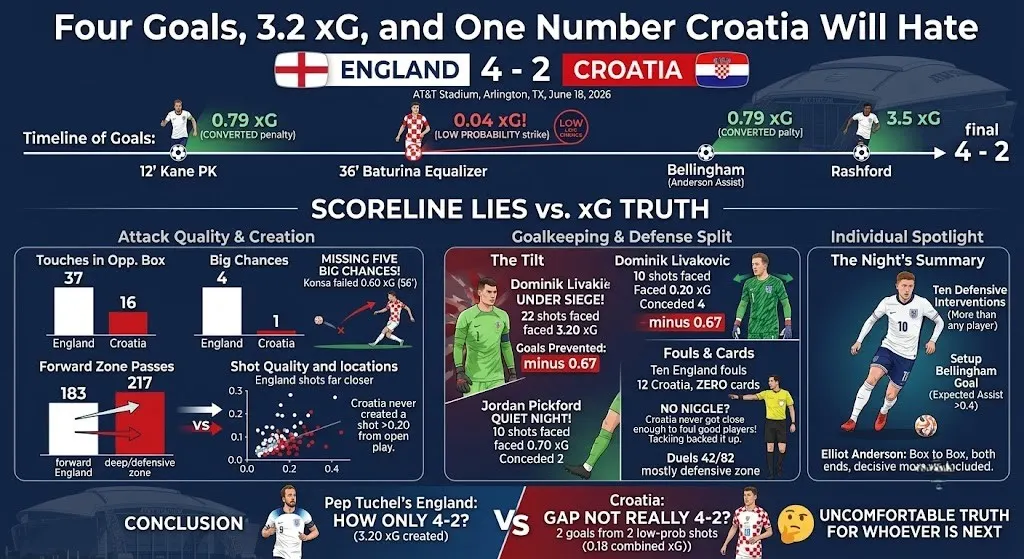
Four Goals, 3.2 xG, and One Number Croatia Will Hate
England beat Croatia 4-2 at AT&T Stadium in Arlington, Texas on June 18, 2026, in their Group L match at the 2026 World Cup. Harry Kane scored twice, Jude Bellingham added a third, and Marcus Rashford sealed it from the bench. Strip away the scoreline and look at the expected goals instead. England racked up 3.20 xG to Croatia’s 0.70. That gap is not close. It is the kind of gap that makes a four-goal away win look almost conservative.
Make no mistake, this was not a tight contest decided by fine margins. It only looked tight twice, both times for a matter of minutes.
Kane converted a penalty in the 12th minute, worth 0.79 xG on its own, then Martin Baturina equalized from outside the box in the 36th with a strike worth just 0.04 xG. That is the first contradiction worth sitting with. Croatia’s two goals came from a combined xG of 0.18, a deflected long-range effort and a far-post header converted from close range. Neither shot should have gone in most of the time. England, by contrast, missed five big chances and still scored four.
Possession sat at 52 to 48 in England’s favor, which tells you almost nothing on its own. Here is what it actually produced. England had 37 touches in the Croatia box compared to 16 the other way, and they created four big chances to Croatia’s one. Their passing was not just more frequent, it was sharper in the right areas, with 183 forward-zone passes against Croatia’s 217 in their own defensive zones. Croatia held the ball plenty in deep positions. They just did very little with it once they got forward.
Shots told a similar story. England fired 22 attempts to Croatia’s 10, with 11 on target against five. But raw shot counts hide the real gap, which is shot quality. England’s average shot location sat far closer to goal, and three of their efforts carried an xG above 0.5, including Kane’s penalty and a 0.60 chance Ezri Konsa somehow failed to convert in the 56th minute. Croatia never created a shot above 0.20 from open play all match.
Then there is the goalkeeping split, and this is where the match really tilts. Jordan Pickford faced ten shots and conceded an expected 0.70 goals worth of danger, finishing with a goals-prevented figure near zero. Dominik Livakovic faced 22 shots worth 3.20 expected goals and conceded four, leaving him at minus 0.67 goals prevented. One keeper had a quiet night. The other was under siege from the second minute to the last.
Fouls and cards barely register here, and that itself is a stat worth reacting to. Ten fouls from England, twelve from Croatia, zero cards shown to either side across 96 minutes of a World Cup group match with this much riding on it. For a game this lopsided in quality, the lack of niggle says Croatia never got close enough to England’s good players to need to foul them. Their tackling numbers back it up. Croatia won 42 of 82 duels, marginally more than England, but duels won in your own defensive third do not show up on a scoreboard.
If there is one individual number that sums up the night, it belongs to Elliot Anderson. He made ten defensive interventions, more than any player on the pitch, and still found time to set up Bellingham’s goal with a driven pass that carried an expected assist value over 0.4. Box to box, both ends, decisive moment included.
Croatia will point to two goals from two low-probability shots and tell themselves the gap was not really four to two. Pep Tuchel’s England will point to 3.20 expected goals and ask how this only finished 4-2. Both of those readings are true at the same time, and that is the uncomfortable part for whoever plays England next in this group.