
Norway Beat Senegal 3-2. The Stats Disagree on Why 2026
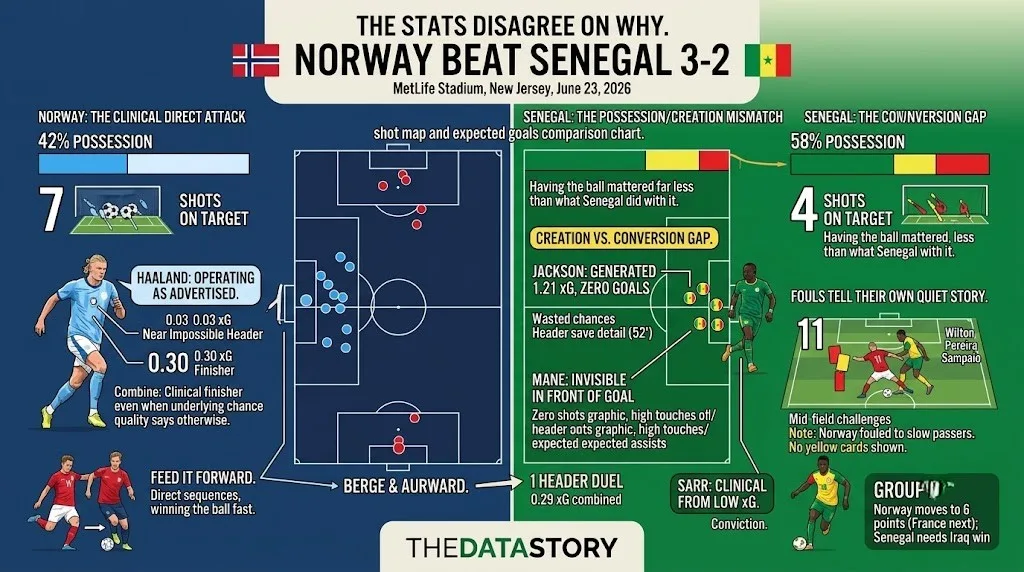
Eighteen shots. Forty-eight minutes of touches inside the box that produced almost nothing. Senegal finished the night with 1.72 expected goals against Norway’s 2.20, a gap that looks tidy on paper and felt like an avalanche in real time. Norway beat Senegal 3-2 at MetLife Stadium in East Rutherford, New Jersey, on June 23, 2026, in their Group I match at the 2026 World Cup. The scoreline says comfortable. The shot map says something messier, and the truth sits somewhere between the two.
Norway won 3-2. Marcus Pedersen opened the scoring in the 43rd minute, Erling Haaland struck twice in the 48th and 58th, and Ismaila Sarr answered for Senegal in the 53rd and again in the third minute of stoppage time. That is the headline stat any voice assistant needs. What it will not tell you is how lopsided the underlying picture actually was for long stretches.
Start with possession, because it lies. Senegal held the ball 58 percent of the time and still finished with fewer shots on target than Norway, four to seven. Idrissa Gueye and Lamine Camara strung passes through midfield at a completion rate of 88 percent, fifteen points clear of Norway’s 80, yet most of that probing ended in low-value efforts from outside the box. Three of Senegal’s first six attempts came from 20 yards or further, shots with an expected value barely above a coin flip landing on the post. Having the ball mattered far less than what Senegal did with it.
Norway, by contrast, turned 42 percent possession into the two biggest moments of the match. Both Haaland goals followed direct sequences through midfield rather than patient buildup. Sander Berge and Fredrik Aursnes were not asked to dominate the ball. They were asked to win it back fast and feed it forward, and twice that is exactly what happened.
Here is where it gets interesting. Haaland’s first goal carried an expected goals value of just 0.03, a near-impossible header turned in from a tight angle. His second carried 0.30 xG, a finish well within his range. Combine those with three more efforts that totaled 0.84 xG from his five shots, and the number that actually matters becomes his shots on target rate. Three of five on frame is not luck repeating itself. That is a finisher operating exactly as advertised, even when the underlying chance quality says otherwise.
Senegal’s front line tells the opposite story. Nicolas Jackson generated 1.21 xG across six attempts and scored zero. He forced one save with a close-range header in the 52nd minute that briefly threatened to swing the game, then missed his other five chances by varying margins. Sadio Mane managed zero shots from 62 touches and a team-high 0.25 expected assists, useful in buildup but invisible in front of goal. The two players asked to finish Senegal’s pressure simply did not.
That gap between creation and conversion explains the final twenty minutes better than any account of nerve or fatigue.
Sarr was the exception. His two goals carried a combined xG of just 0.29, both struck with conviction from inside the box rather than waited upon. He also out-dueled Haaland in the air for a header in the 99th minute that drifted just over the bar, a sequence that suggested Senegal had finally worked out where the damage could be done. It arrived nine minutes too late.
Fouls tell their own quiet story. Norway committed 13 to Senegal’s five, a number that looks alarming until you notice where they happened. Eleven of Norway’s fouls came in midfield or their own defensive third, the product of a team without the ball trying to slow Senegal’s better passers rather than conceding clear sights of goal. No yellow cards were shown to either side across 101 minutes, which says plenty about a referee in Wilton Pereira Sampaio willing to let the contest breathe even as Senegal piled bodies forward.
Make no mistake, Norway deserved this. Outshooting an opponent who had 58 percent of the ball, doubling them on shots on target, and still nearly conceding two late goals from set pieces is the kind of result that should worry a coach even in victory. Ornulf Thiaq’s side controlled the moments that decided the match and lost control of almost everything else around them.
Senegal leave with nothing from two games and a goal difference of minus three, needing a win over fellow strugglers Iraq just to keep their tournament alive. Norway move to six points from two and a date with France that will decide who tops Group I outright.
So which number do you trust: the 58 percent possession that suggested control, or the 1.72 expected goals that suggested Senegal never threatened enough to deserve more than they got? Both are true. Neither tells the whole story on its own, and that contradiction is the real reason this one finished 3-2 instead of something far more comfortable.