
Fifteen Shots Inside the Box. Zero of Them From Qatar’s Night in Vancouver 2026
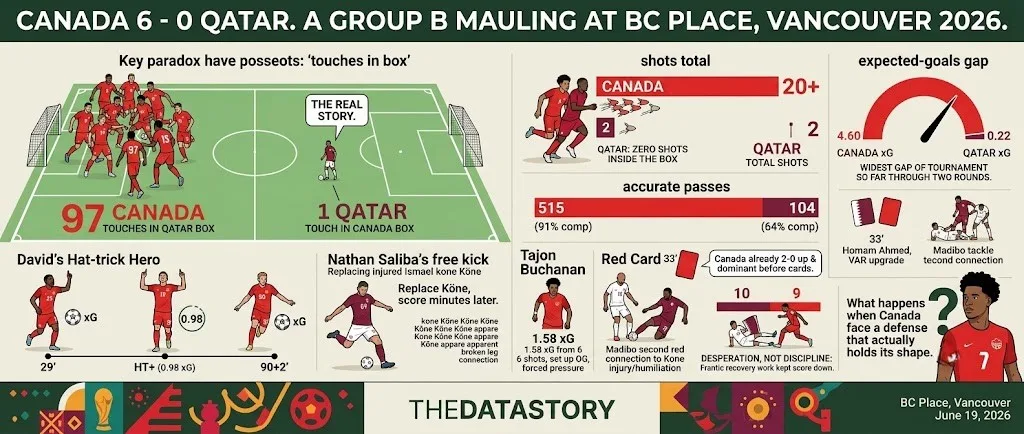
Canada beat Qatar 6-0 at BC Place in Vancouver on June 19, 2026, in their Group B match at the 2026 World Cup, and the scoreline somehow undersold how lopsided it was. Ninety-seven touches in the Qatar box against one tells the real story of this Group B mauling. Most readers will assume the two red cards explain everything here. They do not. Canada were already 2-0 up and dominant before Qatar were reduced to ten men, and the xG numbers back that up completely.
Canada beat Qatar 6-0, with Jonathan David scoring a hat-trick in the 29th minute, first-half stoppage time, and the 90th-plus-second minute. Cyle Larin opened the scoring in the 16th minute, Nathan Saliba curled in a free kick in the 64th, and Mohamed Manai turned the ball into his own net in the 75th. Canada finished with 4.60 xG to Qatar’s 0.22, the widest expected-goals gap of the tournament so far through two rounds.
Here is the number that actually defines this match. Qatar managed two shots in ninety minutes. Two. Not two on target, two total. That is not a team that got unlucky against a stronger opponent. That is a team that was never in the game.
Canada’s xG of 4.60 came almost entirely from open play, with 3.77 of it generated before any set piece intervened. That tells you this was not a side feeding off Qatar’s red cards. Jonathan David alone produced 1.98 xG from five shots on target, a number that would be a strong match for most strikers and was instead one player’s contribution to a six-goal rout. Tajon Buchanan added 1.58 xG from six shots without scoring himself, setting up the own goal and forcing the kind of pressure that eventually broke Qatar’s back line completely.
Possession told a similar story. Canada had the ball 79 percent of the time and turned it into 515 accurate passes at 91 percent completion, compared with Qatar’s 104 passes at 64 percent. That gap is not about Qatar choosing to sit deep and counter. Their defensive interventions, sixty-one in total against Canada’s thirty-nine, show a team that spent the match chasing shadows rather than executing a plan.
The cards matter, but maybe not for the reason most will assume. Homam Ahmed’s red card in the 33rd minute, upgraded by VAR from a yellow, removed a defender just as Canada were finding their rhythm. Assim Madibo’s second red, for the tackle that left Ismael Kone with an apparent broken leg, turned a bad night into a humiliation. Still, Canada had already scored twice and were out-shooting Qatar eleven to nothing before either dismissal changed the numbers.
Make no mistake, the foul count tells its own story too. Qatar committed ten fouls to Canada’s nine, a fairly even split on paper. What that number hides is desperation. Qatar’s defenders made twenty-one and sixteen defensive interventions apiece from their center backs, well above what a settled defense would need. Frantic recovery work, not discipline, kept the score from climbing even higher.
David’s hat-trick will get the headlines, and it deserves them. Three goals from 0.10, 0.98, and 0.62 xG chances respectively shows a finisher who punished both half-chances and gifts with equal coldness. Saliba’s free kick, struck within minutes of replacing the injured Kone, carried a different kind of weight entirely.
So here is the open question nobody wants to ask yet. Canada have now scored six goals in a World Cup match for the first time in their history, but they have done it against a Qatar side that registered an xG of 0.22 and barely crossed the halfway line with intent. What happens when Canada face a defense that actually holds its shape.