
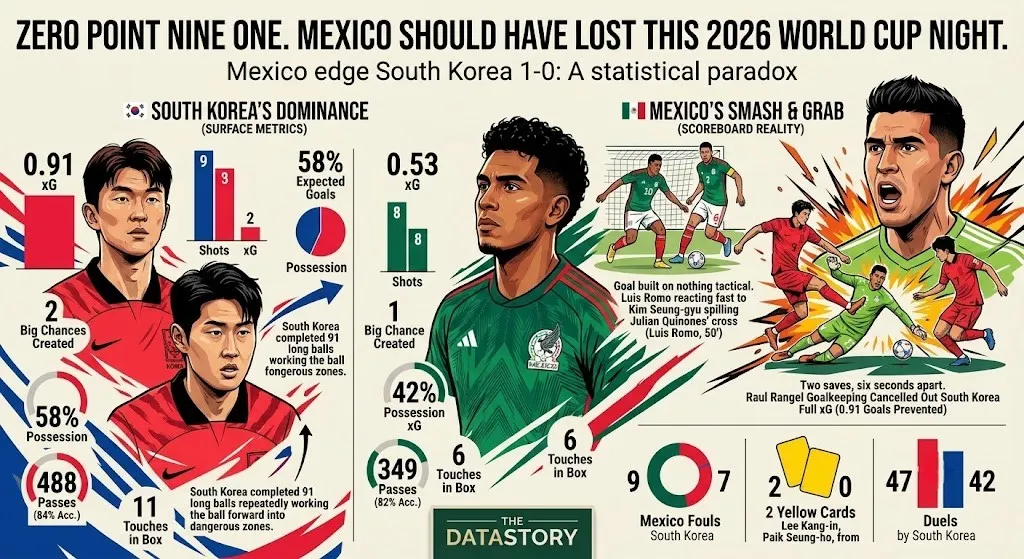
Zero Point Nine One. Mexico Should Have Lost This 2026 World Cup Night
South Korea finished with an expected goals total of 0.91 to Mexico’s 0.53. That is not a marginal gap. That is the kind of number that should sit next to a draw, maybe even a defeat, not a perfect record. Mexico beat South Korea 1-0 at Estadio Akron in Guadalajara on June 19, 2026, in their Group A match at the World Cup, and the scoreline says control. The underlying numbers say something far closer to a smash and grab.
Here is the direct answer. Luis Romo scored the only goal in the 50th minute, pouncing after South Korea goalkeeper Kim Seung-gyu spilled a cross from Julian Quinones under pressure from Lee Gi-hyuk. Mexico’s win confirmed them as the first team through to the knockout stage of the 2026 World Cup, and they finish Group A on six points from two games, three clear of South Korea in second.
Why Mexico Won Despite Losing the Underlying Numbers
Strip away the result and look at the shot map. South Korea had nine shots to Mexico’s eight. They created two big chances to Mexico’s one. They completed 488 passes at 84 percent accuracy, against Mexico’s 349 at 82 percent. Hong Myung-bo’s side had 58 percent of the ball in a match where Mexico were chasing a result from the 50th minute onward. None of it mattered because they could not put the ball in the net, and Mexico could.
Raul Rangel is the reason this is a story about goalkeeping rather than failure. In the 87th minute, with Mexico clinging to their lead, Cho Gue-sung met a cross from substitute Eom Ji-sung with a close-range header that Rangel somehow turned away from the centre of his goal. Seconds later Yang Hyun-jun arrived for the rebound and Rangel saved that too, palming it away from point-blank range. Two saves, six seconds apart, worth more than anything else Mexico did in the second half. Rangel finished with two stops on two shots on target and a goals-prevented figure of 0.91, exactly matching South Korea’s full xG total. Every expected goal South Korea generated, his goalkeeping cancelled out.
Truth is, the first half explains very little about the second. Mexico managed three shots before the break and neither side threatened the goal frame in a half that ended goalless and forgettable. Quinones headed wide in the 20th minute from 12 yards, the best of a thin collection. South Korea were calmer in possession even then, just without end product, a pattern that would define their entire night.
The goal itself was built on nothing tactical. Quinones swung a cross into the six-yard box, Kim Seung-gyu came to claim it and could not hold on, and Romo reacted fastest among four bodies crowded around the loose ball. He drove a right-footed shot into the unguarded net from the centre of the box. Mexico had generated 0.07 expected goals from that passage of play. They got a goal worth far more than the chance deserved, the kind of moment that wins tournaments and gets forgotten the moment the next round starts.
What South Korea Must Fix Before Facing South Africa
South Korea will point to Hwang In-beom and Lee Kang-in pulling strings in midfield, and they would not be wrong. South Korea completed 91 long balls compared to Mexico’s 71, repeatedly working the ball forward into dangerous zones. Eleven touches inside the Mexico box compared to Mexico’s six tells the same story from another angle. Forty-seven duels won against 42. By most measures available, this was the better team on the night. They are also the team going home with a draw needed against South Africa just to guarantee safe passage, while Mexico have already booked their spot in the last 32.
Nine fouls from Mexico against seven from South Korea, two yellow cards shown to South Korea’s Lee Kang-in and Paik Seung-ho, nothing from Mexico. Even the discipline numbers lean toward Mexico playing the more controlled, patient game while conceding territory. Make no mistake, that patience was rewarded with three points it arguably did not earn.
Estadio Akron has now hosted 19 World Cup matches across its history including this one, and every single one has produced at least a goal. No city has hosted more World Cup matches without a scoreless draw. Guadalajara keeps finding a way to settle these things, and on this night it settled in Mexico’s favor by the width of one goalkeeper’s reflexes.
Mexico move on with a perfect record and a home draw in the last 32 still alive as a possibility. South Korea move on to South Africa needing a result that should, in theory, be straightforward against a side with one point from two games. But if a performance this strong by the underlying numbers still ends in defeat, what exactly does South Korea need to change, and what does it say about a tournament where the better team on paper keeps finishing on the wrong side of the scoreline?