
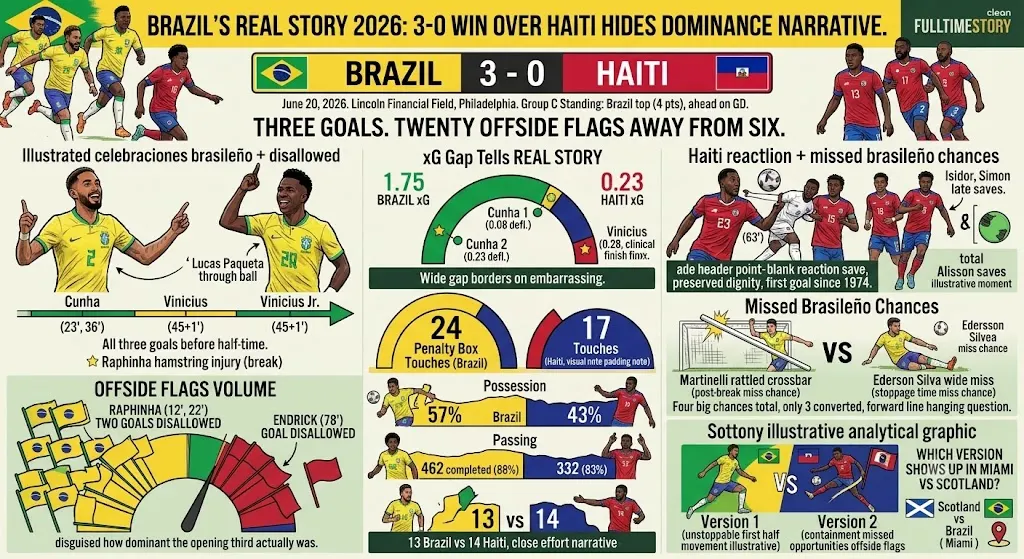
Three Goals. Twenty Offside Flags Away From Six. Brazil’s Real Story 2026
Twenty-four touches inside the penalty box. That number belongs to Brazil, and it is the figure that actually explains a 3-0 scoreline that otherwise looks like a straightforward demolition. Brazil beat Haiti 3-0 at Lincoln Financial Field in Philadelphia on June 20, 2026, in their Group C match at the World Cup, and the final score barely hints at how often Raphinha and Vinicius Junior were waved back for offside before the goals finally started counting.
Here is the direct answer. Matheus Cunha scored twice, in the 23rd and 36th minutes, and Vinicius Junior added a third in first-half stoppage time, finishing off Lucas Paqueta’s through ball. All three goals came before half-time. Brazil move top of Group C on four points, level with Morocco but ahead on goal difference, while Haiti become the first team eliminated from the tournament.
Truth is, the xG gap tells you everything the scoreline cannot. Brazil generated 1.75 expected goals to Haiti’s 0.23, a gap so wide it borders on embarrassing for a side that had been goalless through 22 minutes. Cunha’s opener actually deflected in off a low value chance, just 0.08 xG, while his second arrived from a position worth 0.23. Neither goal was a gift exactly, but neither matched the eventual quality of the finish either. Vinicius closed the half by converting a chance worth 0.28 expected goals, the most clinical of the three.
Raphinha had two goals chalked off for offside inside the opening 22 minutes, in the 12th and again around the 22nd, before going off injured just before the break with what looked like a hamstring problem. Here’s the thing — Brazil were arguably the better attacking side even in the stretch where they were not scoring, and the offside calls disguised how dominant the opening third actually was.
Brazil finished with 57 percent possession and 462 completed passes at 88 percent accuracy, against Haiti’s 332 passes at 83 percent. That gap in passing volume matched the gap in territory. Brazil’s 24 touches in the Haiti box dwarfed Haiti’s 17 touches in the opposite box, a number padded by Brazil sitting deep and content once the lead reached three.
Haiti were not without moments. Ricardo Ade headed a corner goalward in the 63rd minute that Alisson Becker turned away with a point-blank reaction save, denying Haiti what would have been their first World Cup goal since 1974. Wilson Isidor forced two more saves from Alisson late on, in the 87th minute and again deep into stoppage time through Dominique Simon. Three saves total for Alisson, and every single one of them mattered more to Haiti’s dignity than to the final result.
Thirteen fouls committed by Brazil against fourteen from Haiti, with three yellow cards shown to Haiti’s players and one to Brazil’s Douglas Santos. The numbers stayed close even as the scoreline ran away, which says something about effort that the scoreboard does not capture. Haiti kept competing physically long after the match had been decided.
Brazil missed two more big chances after the break, including Gabriel Martinelli rattling the crossbar and Ederson Silva somehow steering a square ball wide from two yards out in stoppage time. Endrick also had a goal ruled out for offside in the 78th minute. Four big chances created in total, with only three converted, leaves a question hanging over a forward line that looked unstoppable for 45 minutes and toothless for the other 45.
So which version of Brazil shows up against Scotland in Miami, the one that built a near-unstoppable first half on pace and movement, or the one that managed nothing more than missed chances and offside flags once the lead felt safe?