
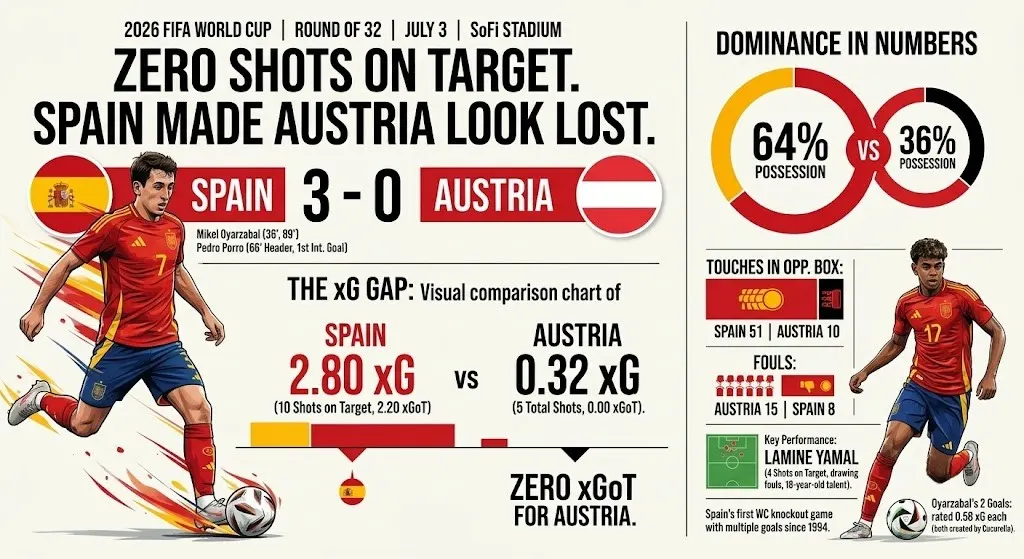
Zero Shots on Target. Spain Made Austria Look Lost 2026
Zero. That is how many shots on goal Austria managed across ninety minutes against Spain in this 2026 World Cup Round of 32 match, a number that turns a routine 3-0 scoreline into something closer to a shutout of intent as well as goals. Spain beat Austria 3-0 at SoFi Stadium in Inglewood, California, on July 3, in a Round of 32 tie that sent the European champions through to face either Portugal or Croatia.
Mikel Oyarzabal scored twice, in the 36th minute and the 89th, both created by Marc Cucurella down the left. Pedro Porro headed in the third in the 66th minute, his first international goal, set up by Alex Baena. Spain finished with 2.80 expected goals to Austria’s 0.32, a gap wide enough that the only real question by full time was how many Spain would end up with, not whether they would win.
What the xG Gap Actually Confirms
That 2.80 to 0.32 split is not a case of one side getting fortunate. Every Austria shot came from distance or a scrambled header, and their expected-goals-on-target figure sat at exactly zero, meaning not one of their five attempts genuinely threatened Unai Simon’s goal. Spain, by contrast, hit 2.20 xG on target from ten shots on frame. Here is the thing worth sitting with: this was not a smash-and-grab result dressed up as dominance. It was dominance, full stop.
Even the goals themselves undersold how comfortable Spain were. Porro’s header carried an xG of just 0.53, a chance most defenders clear nine times out of ten. Oyarzabal’s second, in the 89th, was rated at 0.58 xG. Neither was a gimme. Both went in anyway.
Possession That Actually Produced Something
Spain held 64 percent of the ball and completed 91 percent of their passes, against 82 percent for Austria. Numbers like that can sometimes describe empty control, sideways passing with no end product. Not here. Spain touched the ball inside Austria’s box 51 times, more than five times Austria’s total of ten, and created three big chances to Austria’s one. Having the ball translated directly into territory, and territory translated into goals.
Lamine Yamal’s involvement tells the same story from an individual angle. The 18-year-old attempted 29 dribbles across the tournament coming into this match, a pace matched by only two teenagers in World Cup history since 1966. Against Austria he forced four shots on target of his own without scoring, drawing fouls and stretching a back line that had no answer for his pace on the right.
Fouls tell a smaller but honest story too. Austria committed 15 fouls to Spain’s eight, a rate above their tournament average, and picked up their only yellow card of the match in the 83rd minute once the result was already settled. That is not niggle born of a tight contest. It is a team without the ball resorting to stopping bodies because nothing else was working.
Spain, remarkably, are unbeaten in five straight meetings with Austria and have now scored multiple goals in a World Cup knockout game for the first time since 1994, three decades to the day. Whether that run means anything against Portugal or Croatia is a different conversation, one built on a much higher defensive standard than Austria managed to offer here.
So the real question is not whether Spain deserved this. Zero shots on target settles that argument on its own. It is whether a performance this clean against a limited opponent tells us anything real about how Luis de la Fuente’s side will hold up once someone finally makes them work for it.