
1.05 xG Beat 2.61. Norway Still Have Brazil’s Number 2026
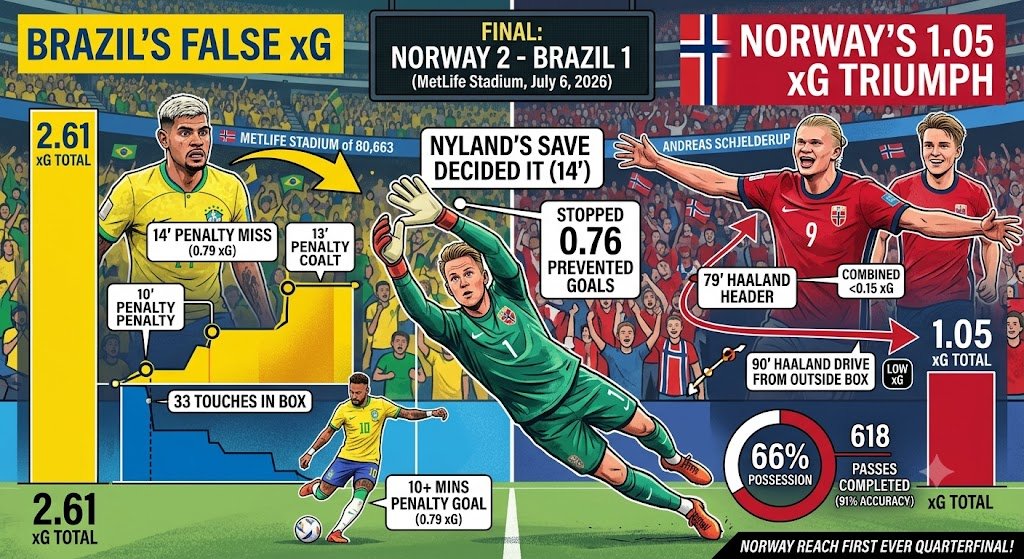
Norway produced 1.05 expected goals across ninety minutes against Brazil. Brazil finished with 2.61. Norway won anyway, and that gap between chance quality and the final score is the real story here, not the scoreline everyone will remember two weeks from now. Norway beat Brazil 2-1 at MetLife Stadium in East Rutherford, New Jersey, on July 6, 2026, in the round of 16 of the World Cup, sending the Nordic nation to their first ever quarterfinal. Brazil, five-time champions, are out.
Erling Haaland scored twice, heading home in the 79th minute and driving a second past Alisson Becker from outside the box in the 90th, both created by substitute Andreas Schjelderup. Neymar converted a stoppage-time penalty in the tenth added minute, but it changed nothing.
Two Norway goals from a combined xG barely above 0.15 beat Brazil’s 2.61.
Why One Penalty Built Brazil’s False xG
Bruno Guimaraes stepped up in the 14th minute, in front of an electric crowd of 80,663, with an xG value of 0.79 attached to his spot kick alone, close to three quarters of Norway’s entire expected goals total for the match. Orjan Nyland dived to his left and saved it. Neymar’s converted penalty in stoppage time carried an identical 0.79 rating. Strip both penalties out and Brazil’s open play production reads closer to 0.95, barely above Norway’s 0.79 from the run of play. A pair of penalties made the scoreline look one-sided in Brazil’s favor before a ball had even properly moved. It did not stay that way.
Take away Guimaraes’ miss and Brazil created one genuinely clear sight of goal from open play in ninety minutes, Endrick’s spurned one-on-one in the 59th minute worth 0.56 xG. That is not a five-time champion’s attacking night.
Norway Held the Ball, Not Many Chances
Norway kept 66 percent of possession and completed 618 of 681 passes for 91 percent accuracy, well clear of Brazil’s 279 from 331 attempts, or 84 percent. That control produced only five shots on target to Brazil’s four, and just two truly convincing moments across the whole match. Both belonged to Schjelderup, on twice from the bench, first setting up Haaland’s header in the 79th minute and then his second in the 90th. Sixty-six percent of the ball is meant to produce more than two clean chances in a game buzzing with tension. Norway managed exactly that many, and both worked.
Brazil also managed 33 touches inside Norway’s penalty box to Norway’s 15, more than double, despite the wide possession gap. Ten of Brazil’s shots came from inside the box compared with seven of Norway’s, proof that Ancelotti’s side turned their limited spells on the ball into direct, dangerous positions rather than aimless passing. Norway’s control was calm. Brazil’s directness was real. Neither fact cancels out the other.
Big chances created favored Brazil three to two, missed chances finished level at four apiece, and Norway edged the aerial battle eleven duels won to four, a number that lines up neatly with a header winning the game.
Nyland’s Save Decided This Before Haaland Scored
Orjan Nyland finished with four saves from five shots on target and a goals-prevented figure of 0.76, meaning he stopped nearly a full goal more than an average keeper would have given the same shots faced. Alisson Becker finished at minus 0.34, conceding two goals from shots worth only 1.66 expected goals on target. The distance between those two numbers is the difference between a goalkeeper who sent his country to a quarterfinal and one who did not do enough on the night. Nyland’s earliest and biggest contribution came in the 14th minute, turning away Guimaraes’ spot kick with a dive to his left. Everything after that, including further stops from Vinicius Junior and Rayan, was a keeper riding momentum he had already created for himself.
Forty-three duels went to each side, an exact split. Seven fouls for Brazil, six for Norway, one yellow card in the whole match, shown to Neymar in stoppage time for hacking down Martin Odegaard.
Norway have now beaten Brazil in two of four meetings across 28 years, both times by exactly 2-1. Haaland has scored in fourteen straight appearances for his country and sits on seven goals at this World Cup, level with Kylian Mbappe and Lionel Messi in the race for the Golden Boot. Solbakken’s side move on to face the winner of Mexico and England, a stage Norway have never previously reached. Brazil exit having created more expected goals than the team that beat them, a version of losing that no scoreline fully explains. Two penalties built most of that number, and one save decided it before Haaland ever touched the ball in anger. If a five-time champion can out-chance an opponent by more than double the expected goals and still fly home early, what does an expected goals total actually tell anyone anymore?