
Twice Down. Twice Level. Iran’s Comeback Story, 2026
Seventeen shots. That is how many attempts New Zealand managed against Iran, more than double Iran’s tally, yet both sides walked away with the same single point. Iran drew 2-2 with New Zealand at SoFi Stadium in Inglewood on June 16, 2026, in their World Cup Group G opener, and the headline will focus on Iran twice coming from behind. The shot count tells a story of New Zealand generating far more chances and still failing to find a winner.
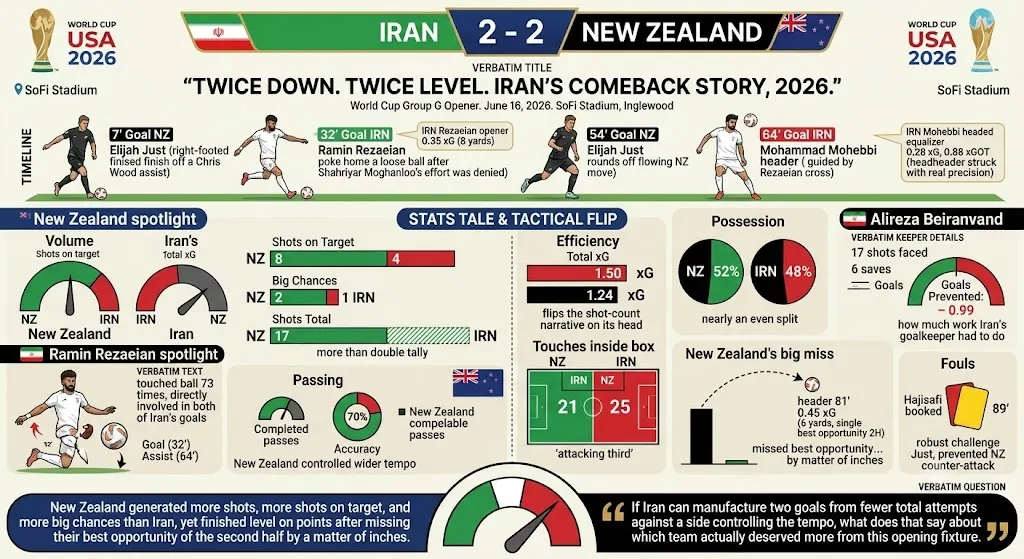
Here is the direct answer first. Elijah Just put New Zealand ahead in the seventh minute with a right-footed finish off a Chris Wood assist. Ramin Rezaeian leveled it for Iran in the 32nd minute, poking home a loose ball after Shahriyar Moghanloo’s effort was denied. Just struck again in the 54th minute, rounding off a flowing New Zealand move, before Mohammad Mohebbi headed Iran level for the second time in the 64th minute, guided in by another precise Rezaeian cross. The match finished 2-2, leaving both sides with a single point each in Group G.
Make no mistake, the expected goals total backs Iran’s comeback as more than just resilience.
Iran finished with 1.50 xG to New Zealand’s 1.24, a number that flips the shot-count narrative on its head. Rezaeian’s opener carried 0.35 xG from eight yards, a genuinely high-value chance he converted cleanly, while Mohebbi’s headed equalizer carried 0.28 xG and an extraordinary 0.88 xGOT once the shot was actually on frame, the kind of number that reflects a header struck with real precision rather than fortune.
Possession sat close, 48 percent for Iran to 52 for New Zealand, nearly an even split across the full ninety-six minutes.
What that near-even possession produced diverged sharply once the ball reached the final third. New Zealand completed 376 passes at 84 percent accuracy against Iran’s 314 at 77, modestly cleaner numbers in build-up play, yet shots on target told a different story entirely, eight for New Zealand against just four for Iran. New Zealand created two big chances to Iran’s one and recorded 21 touches in the Iran box compared to Iran’s 25 inside their own attacking third, numbers that suggest New Zealand controlled the wider tempo while Iran made their moments count.
Truth is, Finn Surman’s missed header in the 81st minute summarized New Zealand’s night better than any goal did. The chance carried 0.45 xG from six yards out, the single best opportunity of the second half for either side, and it sailed over the bar with the scores still level. Alireza Beiranvand faced seventeen shots in total and made six saves, finishing with a goals prevented figure of minus 0.99, a number that reflects just how much work Iran’s goalkeeper had to do across the full match.
Fouls and cards reveal a contest that stayed mostly clean given the stakes. Iran committed ten fouls to New Zealand’s eight, with Ehsan Hajisafi the only player booked, picking up a yellow card in the 89th minute for a robust challenge on Just that prevented a late New Zealand counter-attack.
One individual stat captures the match better than any other. Rezaeian touched the ball 73 times, scored Iran’s opening goal, and then assisted Mohebbi’s equalizer with a perfectly placed cross to the edge of the six-yard box, directly involved in both of Iran’s goals across a match where his side trailed twice and never led once.
So here is the open question this draw leaves behind. New Zealand generated more shots, more shots on target, and more big chances than Iran, yet finished level on points after missing their best opportunity of the second half by a matter of inches. If Iran can manufacture two goals from fewer total attempts against a side controlling the tempo, what does that say about which team actually deserved more from this opening fixture.