
One Point Eight Five. Haaland’s Debut xG Alone, 2026
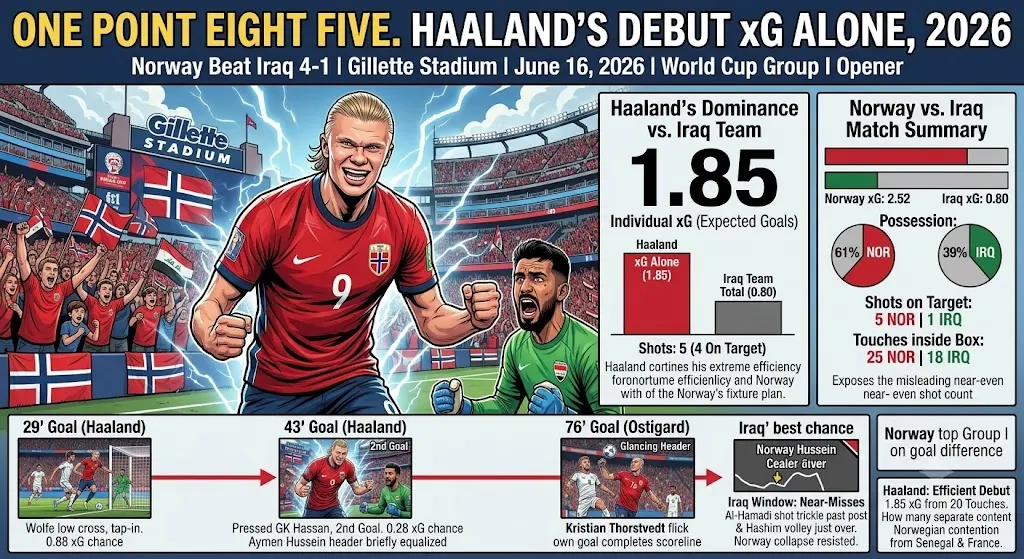
One point eight five expected goals. That is what Erling Haaland generated by himself, more than double Iraq’s entire team output for the match. Norway beat Iraq 4-1 at Gillette Stadium in Foxborough on June 16, 2026, in their World Cup Group I opener, and Haaland scored twice on his tournament debut. The scoreline reads like a striker finally arriving on the big stage. The number above says he should have scored even more.
Here is the direct answer first. Haaland tapped in at the back post in the 29th minute from David Moller Wolfe’s low cross, then closed down goalkeeper Jalal Hassan to make it 2-1 in the 43rd minute after Aymen Hussein had briefly leveled for Iraq with a towering header. Leo Ostigard added a third in the 76th minute, glancing home a Martin Odegaard corner, before Hussein turned a Kristian Thorstvedt flick into his own net in stoppage time to complete a 4-1 scoreline. Norway move top of Group I on goal difference, level on points with France.
Make no mistake, the expected goals split confirms this was not a contest in any meaningful sense.
Norway finished with 2.52 xG to Iraq’s 0.80, more than triple their opponent’s total. Haaland’s first goal alone carried 0.88 xG from four yards out, the kind of chance that should be converted nearly every time, and he added another worth 0.28 xG just before halftime. Iraq’s only goal, by contrast, came from a header worth just 0.08 xG that found the net at 0.60 xGOT, a strong finish on a moderate chance rather than the product of sustained pressure.
Possession sat at 61 percent for Norway to Iraq’s 39, a gap that mirrored the broader story of control throughout.
What that possession produced widened the gap even further. Norway completed 477 passes at 89 percent accuracy against Iraq’s 271 at 81, and touches inside the box reached 25 for Norway compared to just 18 for Iraq. Shots on target told the most lopsided story of all, five for Norway against a single attempt for Iraq across the entire match, despite Iraq actually generating eleven shots in total to Norway’s twelve, a near-even raw count that the quality numbers expose as misleading.
Truth is, Iraq’s resistance in the final ten minutes of the first half nearly produced a different outcome. Ali Al-Hamadi saw his shot trickle just past the post in first-half stoppage time, on a chance worth 0.14 xG, while Akam Hashim’s volley flew narrowly over from the edge of the box moments later. Those two near-misses represented Iraq’s best window to draw level before Norway pulled away for good in the second half.
Fouls and cards revealed a match that grew slightly tetchy as the gap widened. Iraq committed twelve fouls to Norway’s thirteen, a close split, but Zaid Tahseen picked up Iraq’s only yellow card in the 86th minute for a foul on Haaland, a booking that came as Norway’s young striker continued pressing for a hat-trick that Hassan ultimately denied him with a strong save in the 83rd minute.
One individual stat sits above every other number from this match. Haaland touched the ball just twenty times, registered five shots, four of them on target, and finished with 1.85 xG on his own, a tally that exceeded Iraq’s entire team output and explains exactly why Norway’s coaching staff built their opening fixture plan around getting him into the box as quickly and as often as possible.
So here is the open question Norway now carry forward. Haaland generated nearly two full expected goals from just twenty touches in his World Cup debut, a level of efficiency that even elite strikers rarely sustain across a full tournament. If he keeps producing chances at this rate against Senegal and beyond, how many goals separate Norway from genuine contention, and how many from a Group I field that already looks thin behind France.