
Twelve Minutes of Stoppage. One Penalty. Austria’s Edge, 2026
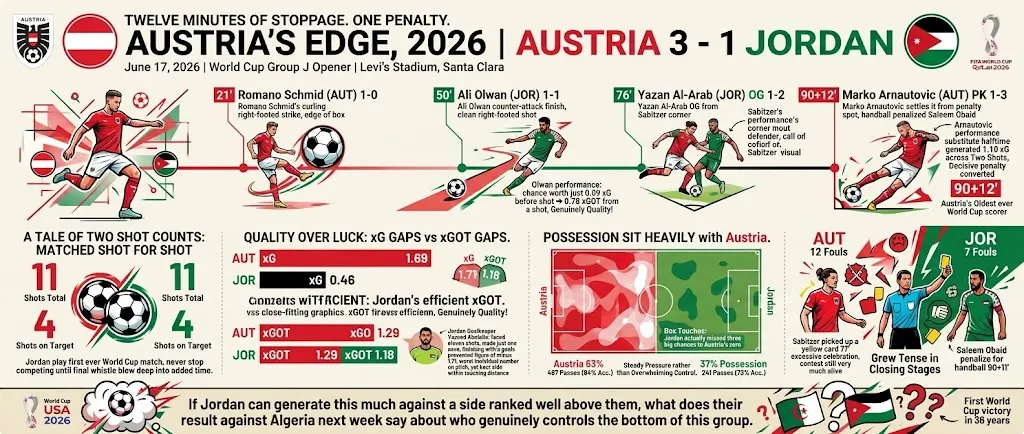
Twelve minutes of stoppage time. That is how long it took Austria to actually finish off a Jordan side that matched them shot for shot for most of the night. Austria beat Jordan 3-1 at Levi’s Stadium in Santa Clara on June 17, 2026, in their World Cup Group J opener, and the scoreline suggests a routine win for the European side. The shot count says Jordan, playing their first ever World Cup match, never stopped competing until the final whistle blew deep into added time.
Here is the direct answer first. Romano Schmid opened the scoring in the 21st minute with a curling right-footed strike from the edge of the box. Ali Olwan leveled it for Jordan in the 50th minute, finishing a counter-attack with a clean right-footed shot. Yazan Al-Arab turned a Marcel Sabitzer corner into his own net in the 76th minute to restore Austria’s lead, and Marko Arnautovic settled it from the penalty spot in the twelfth minute of stoppage time after Saleem Obaid was penalized for handball. Austria finished 3-1 winners, claiming their first World Cup victory in 36 years.
Make no mistake, the raw shot count from this match tells a story the scoreline does not.
Both sides finished level at eleven shots apiece, and both registered exactly four shots on target. Austria’s expected goals total reached 1.69 to Jordan’s 0.46, a meaningful gap, yet Jordan’s xG on target actually climbed to 1.18, nearly matching Austria’s 1.29 figure once shots actually found the frame. Olwan’s equalizer alone carried 0.78 xGOT from a chance worth just 0.09 xG before the shot, the kind of conversion that reflects genuine quality rather than fortune.
Possession sat heavily with Austria, 63 percent to Jordan’s 37, a gap that explains more about territory than about danger created.
What Austria did with that possession produced steady pressure rather than overwhelming control. They completed 487 passes at 84 percent accuracy against Jordan’s 241 at 73, and touches inside the box reached 28 for Austria compared to 21 for Jordan, numbers close enough to suggest a contest rather than a mismatch. Jordan actually missed three big chances to Austria’s zero, a statistic that points toward genuine opportunities squandered rather than a side that never threatened.
Truth is, Jordan’s goalkeeper Yazeed Abulaila faced the heavier defensive burden and still kept his side within touching distance for most of the match. He faced eleven shots and made just one save, finishing with a goals prevented figure of minus 1.71, the worst individual number on the pitch, yet his side still found a way to level the score in the second half before Austria’s own goal and late penalty ultimately decided it.
Fouls and cards revealed a match that grew tense as Jordan chased an equalizer in the closing stages. Austria committed twelve fouls to Jordan’s seven, and Sabitzer picked up a yellow card in the 77th minute for excessive celebration after Al-Arab’s own goal put Austria back in front, a booking that reflected the emotional stakes of a contest still very much alive with fifteen minutes plus stoppage remaining.
One individual stat captures the closing stretch better than any other. Arnautovic, introduced as a substitute at halftime, generated 1.10 xG across two shots, including the decisive penalty converted in the twelfth minute of stoppage time, becoming Austria’s oldest ever World Cup scorer in the process.
So here is the open question this result leaves behind for Group J. Jordan matched Austria shot for shot and shot-on-target for shot-on-target in their first ever World Cup appearance, only to lose by two clear goals through an own goal and a stoppage-time penalty rather than open play. If Jordan can generate this much against a side ranked well above them, what does their result against Algeria next week say about who genuinely controls the bottom of this group.